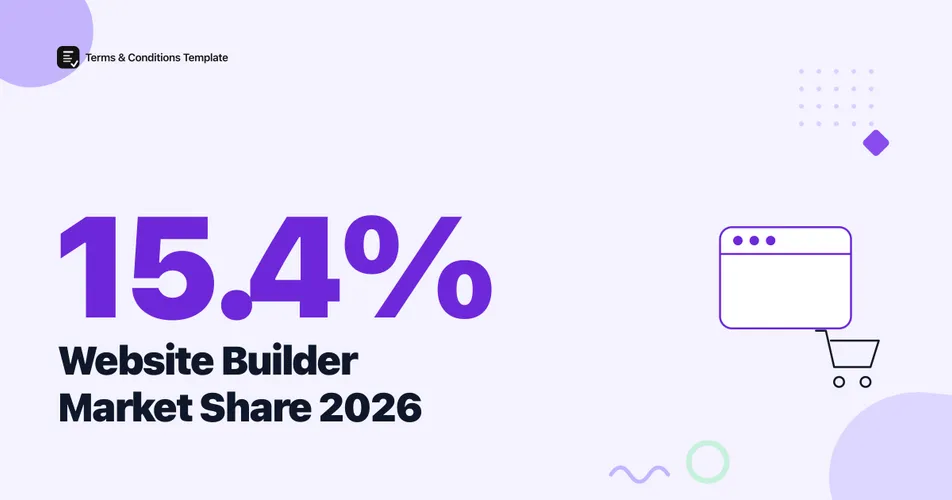
Website builders and hosted ecommerce platforms together run on 15.4% of all websites worldwide, as of a W3Techs web technology crawl checked in July 2026. Shopify holds the largest single share at 5.3% of all sites, ahead of Wix at 4.3% and Squarespace at 2.5%. Here is the full builder-by-builder breakdown and how it stacks up against self-hosted CMS options like WordPress.
Which website builder has the biggest market share in 2026?
Shopify runs the largest share of any hosted builder platform W3Techs tracks: 5.3% of all websites, or 7.6% of sites with a known content management system. Wix follows at 4.3% of all sites (6.1% of the known-CMS group), then Squarespace at 2.5% (3.5%). The remaining tracked builders, Tilda, Webflow, Duda, GoDaddy Website Builder, and Weebly, each hold under 1% of all websites individually.
Figure 1: Combined market share of tracked website builders and hosted ecommerce platforms, as a percentage of all websites. Source: W3Techs, Usage Statistics of Content Management Systems, checked July 2026.
That 15.4% combined figure is a floor, not a ceiling, since W3Techs reports separately that 30.4% of all websites use no monitored CMS or builder it can detect, meaning custom code, static sites, and unclassified platforms still make up a larger share than any tracked builder category. If you generate a compliant terms and conditions document for whichever platform you build on, that document travels with the site regardless of which builder or CMS is underneath it.
Shopify’s lead is driven by its ecommerce focus, not general site building. A platform’s share can look different depending on which comparison set you use.
How does Shopify’s share compare across ecommerce platforms specifically?
Within the narrower ecommerce-systems category, not all websites but specifically stores that W3Techs classifies as running an ecommerce platform, Shopify’s share is even larger: 31.2% of all ecommerce systems it detects, according to the same W3Techs survey. That makes Shopify the single largest ecommerce platform tracked, ahead of the rest of the field combined in relative terms within that category.
| Platform | % of all websites | % of known-CMS websites |
|---|---|---|
| Shopify | 5.3% | 7.6% |
| Wix | 4.3% | 6.1% |
| Squarespace | 2.5% | 3.5% |
| Webflow | 0.8% | 1.2% |
| Tilda | 0.8% | 1.2% |
| Duda | 0.7% | 1.1% |
| GoDaddy Website Builder | 0.6% | 0.9% |
| Weebly | 0.4% | 0.6% |
Source: W3Techs, Usage Statistics of Content Management Systems, checked July 2026.
A store built to sell products sits in a different comparison bracket than a portfolio or small business brochure site, which is why Shopify and Wix rarely compete head to head for the same customer despite both appearing on the same overall leaderboard.
Which builder leads among general-purpose, non-ecommerce platforms?
Excluding Shopify’s ecommerce-specific share, Wix is the largest general-purpose website builder at 4.3% of all websites, ahead of Squarespace, Webflow, Tilda, Duda, GoDaddy Website Builder, and Weebly. Together those seven general-purpose builders run 10.1% of all websites, roughly two-thirds of the full 15.4% combined-builder figure once Shopify’s ecommerce share is set aside.
Figure 2: Market share of general-purpose (non-ecommerce-specific) website builders, ranked by percentage of all websites. Source: W3Techs, checked July 2026.
Wix’s roughly 1.7-times lead over Squarespace has held for several years of W3Techs tracking, and the gap between the top two and the remaining five builders is wide: no single platform outside Wix and Squarespace clears 1% of all websites on its own.
How does the combined builder market compare to self-hosted WordPress?
WordPress alone runs 41.2% of all websites and 59.1% of sites with a known CMS, according to the same W3Techs survey, which dwarfs the 15.4% combined share of every hosted builder and ecommerce platform tracked. WordPress is a self-hosted, open-source CMS rather than a proprietary hosted builder, so it is not counted inside the builder total above; see our WordPress market share breakdown for the full self-hosted picture. That distinction, self-hosted and extensible versus hosted and drag-and-drop, is the main reason the two categories are reported separately rather than as one combined figure.
Figure 3: The rough split site owners face between self-hosted CMS, hosted ecommerce, and hosted general-purpose builders. Source: synthesized from W3Techs category data above, checked July 2026.
WordPress’s scale is a reminder that “website builder” and “most popular way to run a website” are not the same claim. Hosted builders lead on ease of setup, not on raw share of the web.
How has the hosted builder space grown over time?
Every major hosted builder in this data launched inside a fairly narrow founding window, and most of the platforms with meaningful 2026 market share today are between 13 and 23 years old, not recent entrants. Squarespace launched publicly in 2004, Wix and Shopify both launched in 2006, Weebly also launched in 2006, Duda followed in 2009, and Webflow, the newest platform in the current top tier, launched its public builder in 2013.
Figure 4: Public launch years for the platforms that hold the largest share of the 2026 builder market. Source: publicly stated founding/launch dates for each company.
The current market leaders are not new arrivals. Nearly two decades of iteration separate Squarespace’s 2004 launch from the 15.4% combined share these platforms hold in 2026, which is a longer runway than most competing categories in web publishing get before consolidating around a handful of leaders.
Who is site building for outside of general-purpose and ecommerce platforms?
Small businesses remain the core audience driving builder adoption: 83% of small businesses in the United States now run their own website, per the small business website ownership data covered separately, and the builder platforms in this post are one of the two main routes, alongside self-hosted WordPress, that those businesses use to get online. A newly registered domain is frequently the first step in that process; see our domain registration data for 2026 for how many new domains are being registered as that first step happens.
Every platform in this comparison, hosted builder or self-hosted CMS, needs the same baseline legal documentation once a site goes live. The T&C Generator works the same way regardless of which builder produced the site, since terms and conditions live as a document, not as a builder-specific feature.
The Bottom Line
Hosted website builders and ecommerce platforms combined run 15.4% of all websites in 2026, with Shopify holding the largest single share at 5.3% of all sites and 31.2% of the ecommerce-platform category specifically. Wix leads every general-purpose, non-ecommerce builder at 4.3%, roughly 1.7 times Squarespace’s 2.5%. That combined 15.4% is still smaller than WordPress’s 41.2% self-hosted share on its own, and smaller still than the 30.4% of all sites running no monitored CMS or builder at all. The practical takeaway for a site owner choosing a platform in 2026: the builder decision is mostly about ecommerce needs versus general content versus code control, not about picking whichever platform currently has the largest headline number, since none of the individual builder categories comes close to WordPress’s scale.
Frequently Asked Questions
What percentage of websites use a website builder? 15.4% of all websites worldwide run on a dedicated website builder or hosted ecommerce platform (Shopify, Wix, Squarespace, Webflow, Tilda, Duda, GoDaddy Website Builder, and Weebly combined), according to W3Techs’ web technology survey, checked July 2026.
Which website builder has the largest market share? Shopify runs 5.3% of all websites and 7.6% of sites with a known content management system, the largest single share among hosted builders, per W3Techs (July 2026). Among general-purpose builders that are not ecommerce-specific, Wix leads at 4.3% of all websites.
How does Wix compare to Squarespace? Wix runs 4.3% of all websites (6.1% of sites with a known CMS) versus Squarespace’s 2.5% (3.5%), according to W3Techs, checked July 2026. That makes Wix roughly 1.7 times Squarespace’s share.
Is Shopify a website builder or an ecommerce platform? Shopify is a hosted ecommerce platform that includes website-building tools, distinct from general-purpose builders like Wix and Squarespace. W3Techs tracks it inside the same content management category and reports it also holds 31.2% of all ecommerce systems it detects, the largest single share of that narrower category.
Sources and References
- W3Techs. “Usage Statistics and Market Share of Content Management Systems.” Live, continuously updated crawl survey; figures in this post checked July 2026 (WordPress 41.2%/59.1%, Shopify 5.3%/7.6%, Wix 4.3%/6.1%, Squarespace 2.5%/3.5%, Webflow 0.8%/1.2%, Tilda 0.8%/1.2%, Duda 0.7%/1.1%, GoDaddy Website Builder 0.6%/0.9%, Weebly 0.4%/0.6%, no CMS detected 30.4%).
- W3Techs. “Usage Statistics and Market Share of Shopify.” States Shopify holds 31.2% of all ecommerce systems detected, checked July 2026.
- W3Techs. “Usage Statistics and Market Share of Wix.” Checked July 2026.
- Shopify Investor Relations. Company-disclosed figures: millions of merchants across 175+ countries and greater than 14% US ecommerce market share, self-reported, referenced here for context alongside the independent W3Techs crawl data above, not as a substitute for it.
Note: All figures verified as of July 2026. W3Techs’ content management survey is a live, continuously updated crawl rather than a fixed annual report, so the percentages above should be read as current at time of checking, not as a permanent historical fact; this post notes that limitation rather than presenting the figures as a static one-time measurement. Headline figures here are refreshed at least twice a year.