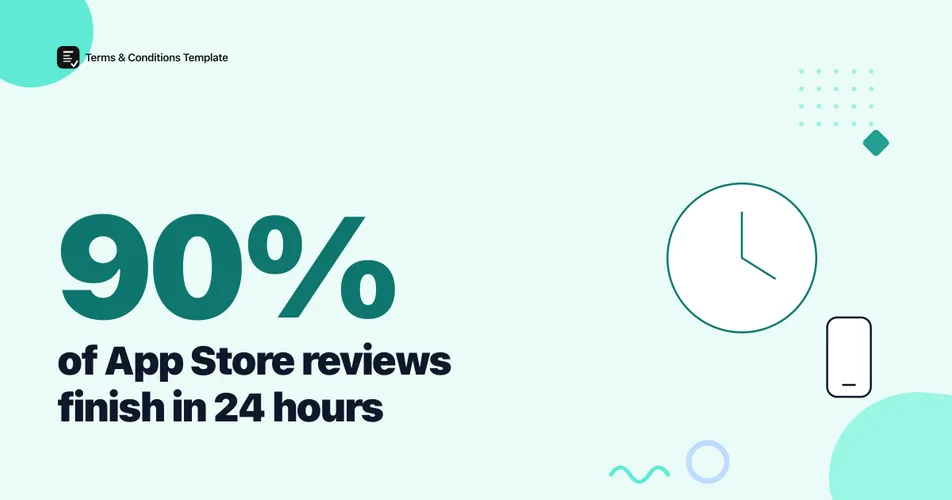
Apple says 90% of App Store submissions are reviewed in less than 24 hours, according to its own App Review status page, checked in July 2026. Google Play’s official help documentation states a wider window: a few hours up to seven days for a standard review, and longer for certain developer accounts under closer scrutiny. Both numbers come straight from the platforms that run the review, not from a third party, and neither publishes an exact median time in hours.
That gap matters for one practical reason: a fast review is not the same thing as an easy one. Apple still rejected roughly 22% of the submissions it evaluated in 2025, and the sections below rank what each platform actually discloses about how long review takes and what slows it down.
How fast does Apple review App Store submissions?
Apple’s App Review status page states that, on average, 90% of submissions are reviewed in less than 24 hours. That is the only turnaround figure Apple publishes on the page; it does not break out a median, a 50th-percentile time, or separate numbers for new apps versus updates. Developers are notified by email of status changes and can also check status inside App Store Connect.
Figure 1: Apple’s own claimed split of how fast submissions clear review. Source: Apple Developer, App Review status page, checked July 2026.
The same page names the single biggest cause of delay: on average, over 40% of unresolved review issues trace back to Guideline 2.1, App Completeness, which covers crashes, placeholder content, incomplete information, and broken links. An app that ships with a working demo account, finished text and images, and no dead links avoids the most common reason a submission sits past the 24-hour mark.
| Metric | Apple’s published figure |
|---|---|
| Submissions reviewed within 24 hours | 90% |
| Unresolved issues tied to Guideline 2.1 (App Completeness) | Over 40% |
| Exact median review time in hours | Not published |
Source: Apple Developer, App Review status page, checked July 2026.
Ninety percent is the headline, but it is a self-reported figure with no published sample size or methodology behind it, which is worth keeping in mind when a 90-percent claim gets repeated as if it were independently audited.
How long does Google Play review take?
Google’s Play Console Help documentation gives a wider, explicitly ranged answer rather than a single percentage. Its guidance on managed publishing states that processing can take a few hours or up to seven days, or longer in exceptional cases, depending on the review your app is subject to. A separate publishing help page adds that some developer accounts get more thorough review specifically to protect users, which can also push review time out to seven days or beyond.
Figure 2: The outer edge of each platform’s own stated review window. Apple’s 24 hours is a 90th-percentile claim; Google’s 168 hours (7 days) is its stated standard-path ceiling, with no upper bound given for accounts under extended review. Source: Apple Developer App Review status page; Google Play Console Help.
Google recommends developers build in at least a week of buffer between submitting an app and going live, which is a materially different planning assumption than Apple’s 24-hour, 90th-percentile claim. Neither company publishes a number that lets you compute an apples-to-apples median, since Apple gives a percentile against a fixed window and Google gives a range with an open-ended tail.
An app that needs a hard launch date on Google Play should plan around the seven-day figure Google itself publishes, not the faster end of the range.
Does a fast review mean an app is likely to get approved?
No. Apple’s own numbers show speed and outcome are separate. Apple evaluated 9.1 million-plus App Store submissions in 2025 and rejected more than 2 million of them, a rejection rate of roughly 22%, according to Apple’s Newsroom fraud-prevention update from May 2026. That rejection rate has actually declined three years running, from 25.6% in 2023 to 24.8% in 2024 to roughly 22% in 2025, even as the 90%-within-24-hours claim held steady across the same period.
Figure 3: Apple’s rejection rate has trended down even as review speed claims stayed constant. Source: Apple 2023 and 2024 App Store Transparency Reports; Apple Newsroom, May 2026.
A EULA generator that documents your app’s in-app purchases, subscription terms, and third-party licensing before submission removes one of the more preventable causes of a first-pass rejection, since Legal issues, privacy disclosures, IP, and compliance language, were the second-largest documented rejection category in Apple’s most recent full transparency report. For the full breakdown of what actually gets an app rejected, see our App Store rejection statistics roundup, and for App Store size, downloads, and revenue context, our App Store 2026 stats covers the full picture this review-time data sits inside.
A 24-hour turnaround tells you how quickly you will hear back. It tells you nothing about whether the answer will be yes.
Does resubmitting after a rejection add real time to the process?
Often, yes, but not always starting from zero. Apple’s 2024 App Store Transparency Report shows 295,109 of that year’s 1,931,400 rejected submissions, 15.3%, were approved after the developer fixed the flagged issue and resubmitted. The 2023 figure was nearly identical at 15.8% (277,923 of 1,763,812), suggesting this resubmission-approval rate has held roughly steady even as raw rejection volume grew.
Figure 4: The path from submission to publication, including the resubmission loop. Source: Apple App Review status page; Apple 2024 App Store Transparency Report.
Each trip through this loop adds at least another review cycle on top of the original one, and Apple’s own review-status page gives no separate turnaround claim for resubmissions versus first-time submissions, so a resubmission is not guaranteed to clear inside the same 24-hour window as the original attempt.
Getting a fast first answer is not the same as getting a fast final answer once a fix and a resubmission are involved.
What compliance changes are adding review overhead in 2026?
Two policy changes landed in the months before Apple’s most recent rejection-rate data was published, and both widen what a reviewer checks before a submission can clear, regardless of how fast the queue itself moves. Apple overhauled its age-rating system in July 2025, adding 13+, 16+, and 18+ tiers on top of the existing 4+ and 9+ ratings, with developers required to answer the new age-rating questions for every app by January 31, 2026. Since April 28, 2026, every new App Store Connect submission must also be built with Xcode 26 or later, targeting an SDK for iOS 26, iPadOS 26, tvOS 26, visionOS 26, or watchOS 26.
Figure 5: Compliance deadlines layered onto App Store review since mid-2025. Source: Apple Developer News.
Neither requirement changes Apple’s published 90%-within-24-hours claim directly, since that figure describes queue speed, not pass rate against newer requirements. A submission built against an unsupported SDK or missing the required age-rating answers is more likely to land in the roughly 22% that gets rejected, which then triggers the resubmission cycle covered above.
Compliance deadlines do not show up in a review-speed statistic, but they show up in how many attempts it takes to get published.
How do Apple and Google’s review processes compare?
| Factor | Apple App Store | Google Play |
|---|---|---|
| Stated standard review window | 90% within 24 hours | A few hours up to 7 days |
| Extended review scenario | Not separately quantified | Up to 7 days or longer for certain accounts |
| 2025 rejection rate | Roughly 22% (9.1M-plus evaluated) | Not published as a directly comparable rate |
| Recommended developer buffer | Not stated | At least 1 week |
Sources: Apple Developer App Review status page (checked July 2026); Apple Newsroom (May 2026); Google Play Console Help.
Google’s help documentation is explicit that it does not publish a rejection rate the way Apple does; it discloses only enforcement counts (apps blocked, accounts banned) with no published denominator of total submissions reviewed, which is why the table above cannot show a true side-by-side rejection percentage.
The Bottom Line
Apple’s 90%-within-24-hours claim and Google’s few-hours-to-seven-days range are both self-published by the platform running the review, not independently audited, and neither company discloses an exact median turnaround in hours. That is still useful information for planning a launch: Apple’s own worst case sits at roughly 24 hours for 9 out of 10 submissions, while Google’s own worst case for a standard review runs up to a week, with no published ceiling for accounts flagged for extended review. Speed and outcome are separate questions on both platforms. Apple rejected about 1 in 5 submissions in 2025 despite its fast queue, and roughly 1 in 7 of those rejections got fixed and approved on resubmission the following review cycle. A EULA that documents in-app purchases, subscriptions, and licensing terms accurately before the first submission removes one of the more preventable reasons a fast review still ends in a rejection.
Frequently Asked Questions
How long does an App Store review actually take? Apple states that 90% of App Store submissions are reviewed in less than 24 hours, according to its App Review status page (checked July 2026). Apple does not publish an exact median or average time in hours, only this 90th-percentile claim.
How long does Google Play take to review an app? Google’s own Play Console Help documentation says review processing can take a few hours or up to seven days, and longer in exceptional cases for certain developer accounts subject to more thorough review.
Does a fast review mean an app is likely to get approved? No. Apple rejected roughly 22% of the 9.1 million-plus submissions it evaluated in 2025, per its May 2026 Newsroom update, even though 90% of those submissions got a verdict within 24 hours. Speed and outcome are two separate numbers.
What happens to review time after a rejection? Resubmission does not restart from zero for every developer. In 2024, 295,109 of 1,931,400 rejected submissions, 15.3%, were approved after the developer fixed the flagged issue and resubmitted, per Apple’s 2024 App Store Transparency Report.
Sources and References
- Apple Developer. “App Review.” Official App Review status page, states 90% of submissions reviewed in under 24 hours and over 40% of unresolved issues tied to Guideline 2.1. Checked July 2026; this is a live, continuously updated page, not a dated report.
- Google Play Console Help. “Control when app changes are reviewed and published.” States review processing can take a few hours or up to seven days, or longer in exceptional cases.
- Google Play Console Help. “Publish your app.” States certain developer accounts may see review times of up to seven days or longer in exceptional cases.
- Apple Newsroom. (2026). “The App Store Stopped Over $2.2 Billion in Fraudulent Transactions in 2025.” 9.1M-plus submissions evaluated, 2M-plus rejected in 2025.
- Apple. (2025). “2024 App Store Transparency Report.” Official PDF: 1,931,400 rejections, 295,109 approved on resubmission (15.3%).
- Apple. (2024). “2023 App Store Transparency Report.” Official PDF: 1,763,812 rejections, 277,923 approved on resubmission (15.8%).
- Apple Developer News. (2025). “Age Rating Updates: Upcoming Requirements.” Official Apple Developer documentation.
- Apple Developer News. (2026). “SDK Minimum Requirements: Upcoming Requirements.” Xcode 26 mandate effective April 28, 2026.
Note: All figures verified as of July 2026. Apple’s App Review status page (source 1) is a live, rolling figure that Apple updates on an ongoing basis rather than a fixed annual report, so the 90% claim should be read as current at time of checking, not as a permanent historical fact. Both platforms’ review-speed claims are self-published by the company running the review, with no disclosed sample size or independent audit; this article notes that limitation rather than presenting either figure as independently verified. Headline figures here are refreshed at least twice a year.