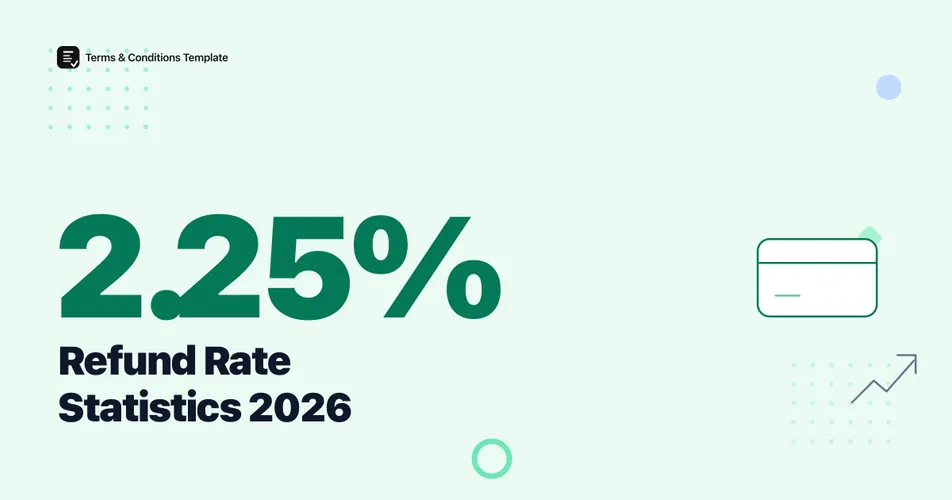
Getting money back is rarer than the returns headlines suggest. Only about 2.25% of purchases were refunded between January and October 2025, according to ACI Worldwide’s analysis of billions of global retail transactions, a figure that climbed to 2.89% in December as holiday returns peaked. Nearly one in five online orders gets sent back, but a much smaller share of total purchases ends in an actual refund landing back in a shopper’s account.
That gap between “returned” and “refunded” matters for anyone running a store. A return that turns into store credit, a partial refund, or a bank dispute is not the same transaction as a clean refund to the original payment method, and the data below breaks out where shoppers actually end up.
How often does a purchase actually get refunded?
Roughly 2.25% of purchases were refunded in the January to October window of 2025, rising to 2.89% in December, according to ACI Worldwide’s Global Ecommerce Report, which analyzed billions of retail transactions rather than relying on a shopper survey. That is the most direct answer to how often money actually comes back: out of every 100 purchases, two to three typically end in a refund, with the holiday season pushing that closer to three.
Figure 1: Share of purchases refunded, by period. Source: ACI Worldwide, Global Ecommerce Report, transaction data, 2025.
Warning
ACI Worldwide does not publish an exact sample size beyond “billions of retail transactions worldwide,” and its November figure is our estimate interpolated between the disclosed January to October average and the disclosed December figure, since ACI’s public release did not break out November on its own. Treat the November bar as directional.
The refund rate stayed under 3% all year even though refund activity itself grew fast: refund volumes rose 18.1% year over year in 2025 and refund value rose 12.7%, which means more purchases overall, not a rising share of each purchase coming back. A store’s total ecommerce growth explains most of that increase, not a spike in how often any single order gets refunded.
Do shoppers get cash back, or store credit?
Most shoppers want the original payment method, not a credit toward a future purchase. 75% of consumers say they want a full refund over store credit, according to Shorr Packaging’s November 2025 survey of 2,013 US consumers. Store credit still gets offered constantly by retailers because it keeps revenue in-house, but it is not what most shoppers are asking for when they start a return.
Figure 2: Shopper preference for refund versus store credit. Source: Shorr Packaging, America’s Return Habits 2025-2026 Consumer Report, n=2,013.
The friction does not stop at payment method. The same survey found 86% of shoppers call free return shipping non-negotiable, and 51% say they draw the line at paying a restocking fee at all. Refund policy for a Refund Policy Generator needs to state the method, the window, and any fees up front, because those three terms are exactly what the survey shows shoppers checking for first.
How many shoppers just give up and keep the item?
A meaningful share of shoppers never complete a return that should have resulted in a refund. 69% of shoppers admit they have kept an item they wanted to return because the process felt like too much hassle, per Shorr Packaging’s 2025 survey. That is a refund that never happened, not because the shopper was satisfied, but because the return process itself was the barrier.
This “abandoned return” pattern shows up alongside two other frictions from the same dataset: 51% resist paying a restocking fee, and 86% consider free return shipping mandatory. Any one of those frictions can turn a planned return into a kept item and a refund that never gets issued.
Figure 3: Where a planned return breaks down before a refund is issued. Source: synthesized from Shorr Packaging, 2025 survey findings above.
A policy that is silent on shipping cost and fees is not neutral. It quietly increases the number of shoppers who keep an unwanted item instead of getting their money back, and 69% is the direct evidence for how common that outcome already is.
What share of retailers charge a fee to process a refund?
Refunds increasingly come with a cost attached before a shopper sees any money. 72% of merchants charged a return fee in the 12 months before the National Retail Federation’s 2025 survey, up from 66% in 2024. That is a one-year jump of six percentage points in how common paid returns have become.
Figure 4: Growth in merchants charging a return fee. Source: National Retail Federation, 2025 Retail Returns Landscape.
The fee is not free for retailers either. Among merchants that started charging for returns, the NRF found 37% lost customers as a result, 34% saw average order value fall, and 24% saw sales decrease outright. A refund policy that discloses a fee clearly, rather than surprising the shopper at the return step, is one of the few variables a merchant controls directly against those numbers. The current fee trend also builds directly on the online return-rate data covered in our ecommerce return rate statistics for 2026, where 19.3% of online orders were returned in 2025.
Do shoppers skip the merchant and go straight to their bank?
A growing share of “refunds” never touch the retailer’s own refund process at all. Nearly half of cardholders say they bypass the merchant entirely and dispute a charge directly with their bank, according to Chargebacks911’s 2025 Cardholder Dispute Index, a survey of more than 1,200 cardholders across the US and UK. The same report found 76% of cardholders prefer resolving a payment dispute through their bank over contacting the seller.
Figure 5: Cardholder preference for dispute resolution path. Source: Chargebacks911, 2025 Cardholder Dispute Index, n=1,200+, US and UK.
A bank-side chargeback still returns money to the shopper, so it counts toward “getting money back” even when it never appears in a merchant’s own refund count. For a retailer, that path is more expensive and more disruptive than an ordinary refund, which is one more reason a clear, visible refund policy that shoppers can act on directly is worth having before a dispute reaches the bank.
How has refund activity moved since 2021?
Refund volume has grown steadily as ecommerce itself has grown, even while the underlying refund rate has stayed in a narrow band under 3%.
Figure 6: Key refund and return-fee milestones. Sources: National Retail Federation, ACI Worldwide.
Refund method compared: cash, store credit, and bank dispute
| Refund path | Share who prefer or use it | Typical speed | Who controls it |
|---|---|---|---|
| Full refund to original payment | 75% of shoppers prefer it | 7 to 10 days | Retailer |
| Store credit | 25% would accept it as first choice | Often instant | Retailer |
| Bank-side chargeback dispute | Nearly half bypass merchant for this | Days to weeks | Card issuer |
Source: Shorr Packaging 2025 Consumer Report; Chargebacks911 2025 Cardholder Dispute Index; NRF/Happy Returns 2025 Retail Returns Landscape.
The Bottom Line
The number that separates the refund story from the returns story is 2.25%, the actual share of purchases that ended in a refund across most of 2025, well below the near-20% online return rate that gets most of the headlines. That gap exists because a return does not automatically become a refund: some shoppers get talked into store credit, some give up and keep the item rather than deal with fees and shipping costs, and a growing share skip the retailer altogether and dispute the charge with their bank instead. A refund policy that states the method, the window, and any fees in plain language, and actually honors a full refund when a shopper asks for one, is what keeps more of those transactions inside the retailer’s own process instead of leaking out to store credit, abandoned returns, or a bank dispute.
Frequently Asked Questions
How often do shoppers actually get their money back? About 2.25% of purchases were refunded between January and October 2025, rising to 2.89% in December, according to ACI Worldwide’s analysis of billions of global retail transactions.
Do shoppers prefer a refund or store credit? 75% of consumers want a full refund over store credit, per Shorr Packaging’s November 2025 survey of 2,013 US consumers. Only a minority accept store credit as a first choice.
How many retailers charge a fee to process a refund? 72% of merchants charged a return fee in the 12 months before the National Retail Federation’s 2025 survey, up from 66% in 2024. Of those, 37% said the fee cost them repeat customers.
Do shoppers go around the merchant and get refunds from their bank instead? Nearly half of cardholders say they bypass the merchant entirely and dispute a charge directly with their bank, according to Chargebacks911’s 2025 Cardholder Dispute Index (n=1,200+, US and UK).
Sources and References
- ACI Worldwide. (2025). “Global Refund Volumes Surge 18% as Retailers Tighten Returns.” Global Ecommerce Report, analysis of billions of retail transactions, 2024-2025 data.
- Shorr Packaging. (2025). “America’s Return Habits: The 2025-2026 Consumer Report.” Survey of 2,013 US consumers, conducted November 2025.
- National Retail Federation and Happy Returns. (2025). “2025 Retail Returns Landscape.” Survey of consumers and ecommerce professionals at US retailers, published October 2025.
- Chargebacks911. (2025). “2025 Cardholder Dispute Index.” Survey of over 1,200 cardholders across the US and UK.
- National Retail Federation. (2025). “Consumers Expected to Return Nearly $850 Billion in Merchandise in 2025.” Press release, October 2025.
Note: All figures verified as of July 2026. Refund rates and dispute behavior shift with holiday seasonality and card-network policy changes, so headline figures here are refreshed at least twice a year.